Vulnerability Scan vs Pen Test: The Complete 2026 Guide
Vulnerability scan vs pen test: what's the difference, when to use each, and how to combine vulnerability and penetration testing in your 2026 security stack.

Vulnerability Scan vs Pen Test: The Complete Guide to Knowing Which You Actually Need
If you've ever sat in a meeting where a vendor pitched "vulnerability and penetration testing" as if they were the same service, you're not alone. The confusion between vulnerability scanning and penetration testing is one of the most expensive misunderstandings in cybersecurity companies routinely pay for one when they actually need the other, and discover the gap only after a breach.
This guide breaks down the real difference between penetration testing and vulnerability scanning, when each one matters, how the prices justify themselves, and how to combine both in a security program that actually works in 2026.
The Short Answer: Vulnerability Scan vs Pen Test
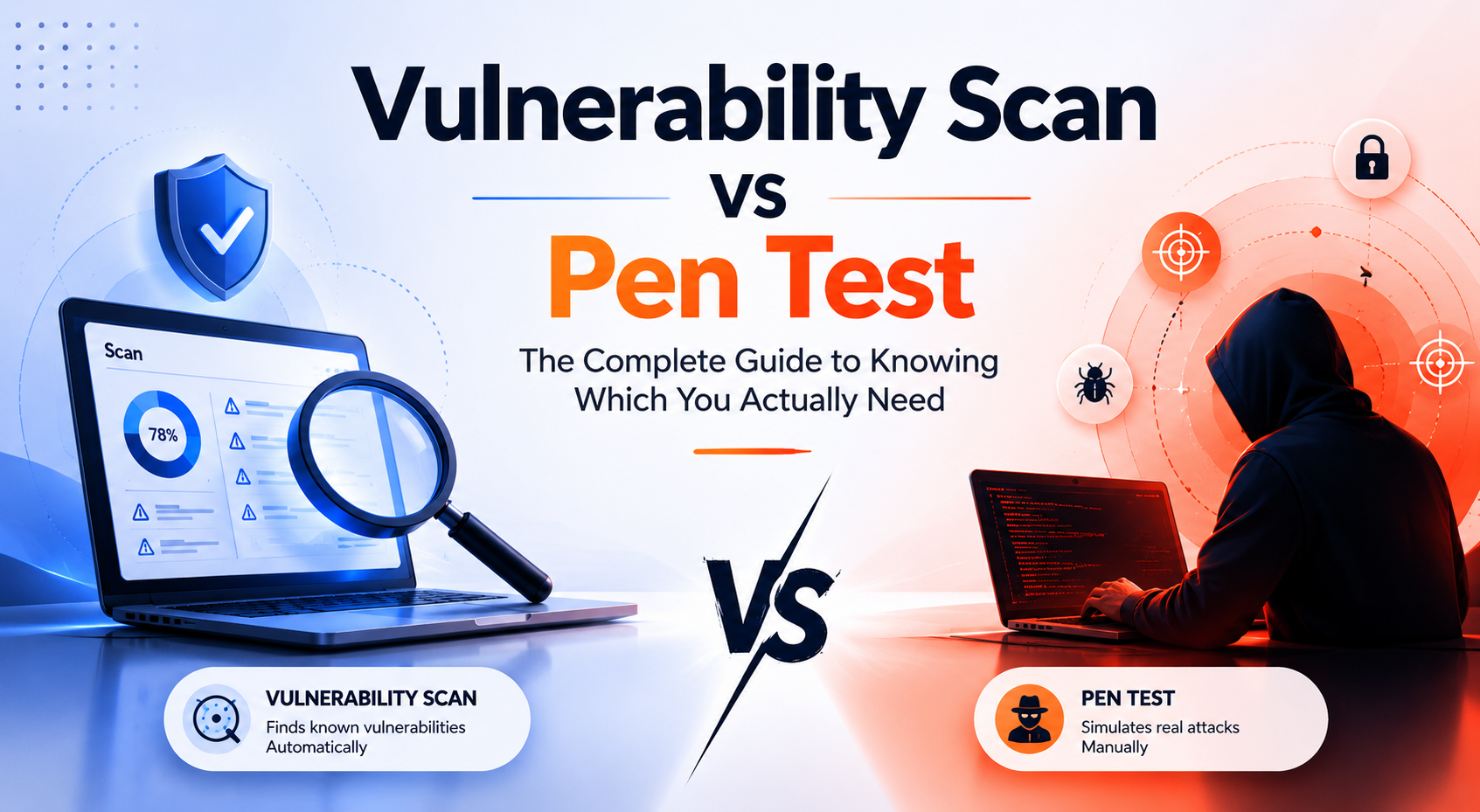
A vulnerability scan is an automated process that compares your assets against a database of known vulnerabilities and outputs a list of potential weaknesses. It's broad, fast, repeatable, and largely automatic.
A penetration test is a manual exercise where a human attacker (or, increasingly in 2026, an autonomous AI agent) actively tries to exploit weaknesses to prove what an adversary could really do. It's deep, slow, contextual, and produces a story not just a list.
If you remember nothing else from this article, remember this: a vulnerability scan tells you what might be wrong. A pen test tells you what an attacker can actually do with what's wrong.
That single distinction explains every other difference between the two.
The Difference Between Penetration Test and Vulnerability Scan, In Detail
Let's break down the difference between vulnerability scanning and penetration testing across the dimensions that actually matter when you're choosing between them.
Depth versus Breadth
A vulnerability scan covers thousands of assets in hours. It's optimized for breadth show me every CVE that might affect any system I own. The trade-off is depth: a scanner reports "this server runs an outdated Apache version that has CVE-2023-XXXXX" but it doesn't try to exploit it, doesn't pivot from it, and doesn't tell you whether that vulnerability is actually reachable in your environment.
A penetration test goes in the opposite direction. It might only cover one application or one network segment, but it goes deep chaining vulnerabilities together, pivoting through systems, and proving exploitability with concrete evidence.
Automated versus Manual (Mostly)
Penetration testing vulnerability scanning workflows historically split cleanly: scans were automated, pentests were manual. That line has blurred significantly in 2026 with the rise of autonomous pentesting agents, but the core principle still holds. Scans run on a schedule with no human intervention. Pentests still require expert judgment whether that judgment comes from a human, an AI agent, or both.
False Positives and Noise
Vulnerability scanners are notoriously noisy. They flag potential issues without verifying exploitability, so you get findings like "this version may be vulnerable to CVE-XXXX-YYYY" even when your specific configuration patches the issue. Triage of vulnerability scan output is itself a full-time job in any serious security team.
Pentests don't have this problem. Every finding in a pentest report comes with proof a screenshot, a captured token, a shell on a compromised host. If something appears in a pentest report, it's real and it's exploitable.
Cost Difference
Here's where the conversation gets practical. Vulnerability scanning costs $50 to $200 per asset per year for SaaS platforms (Tenable, Qualys, Rapid7). Traditional penetration testing runs $20,000 to $50,000 per engagement, performed once a year.
Autonomous pentesting platforms in 2026 sit in between $79 to $700 per month for continuous testing that approaches pentest-quality output. This is a major shift in the vulnerability and penetration testing market that most CISOs haven't fully absorbed yet.
Frequency
Vulnerability scans should run constantly weekly at minimum, ideally daily or continuously. Traditional pentests run annually, sometimes quarterly for high-stakes environments. The frequency gap is exactly why so many breaches happen between scheduled pentests the security posture six months after a clean pentest report is almost never the same as on test day.
Vulnerability Test vs Penetration Test: A Side-By-Side Comparison
If you want a quick reference for the difference between penetration testing and vulnerability scanning, here it is:
Dimension Vulnerability Scan Penetration Test Goal Find potential weaknesses Prove what an attacker can do Depth Broad surface coverage Deep on chosen targets Method Automated, signature-based Manual or AI-driven, exploratory Output List of potential CVEs Narrative of attack chains Validation None potential issues only Proven exploitation with evidence Frequency Continuous/weekly Annual/quarterly (traditional), continuous (autonomous) Cost $50-200/asset/year $20K-50K/engagement or $79-700/month False positives High Effectively zero Business logic flaws Misses them entirely Catches them Best for Compliance, broad coverage Real risk assessment
When You Need a Vulnerability Scan
A vulnerability scan is what you actually need when:
→ Your priority is compliance. PCI-DSS, HIPAA, SOC 2, ISO 27001 most compliance frameworks explicitly require vulnerability scanning at defined intervals. A scan satisfies the requirement; a pentest does not always.
→ You need broad coverage across many assets. If you have 500 servers and want to know which ones are missing patches, a pentest is the wrong tool. A vulnerability scanner covers all 500 in an afternoon.
→ You're tracking remediation over time. Scanners are excellent at trending "we had 1,247 critical findings in January, 612 in February, 89 in March." That kind of operational metric requires automation.
→ Your budget is limited and you're starting from zero. A vulnerability management platform costs a fraction of a pentest and gives you immediate operational benefit. Start here.
When You Need a Penetration Test
You need a penetration test (and not just a vulnerability scan) when:
→ You need to know what an attacker can actually do. A scanner tells you that you have 200 critical CVEs. A pentest tells you that three of them, chained together, let an attacker move from the public internet to your customer database in 47 minutes. That's the kind of information that drives executive action.
→ Compliance requires it. Some standards explicitly mandate penetration testing, not just scanning — PCI-DSS Requirement 11.4, certain SOC 2 audits, and many regulated industries.
→ You've made significant changes to your environment. A new product launch, a cloud migration, a merger these are all triggers for a pentest because vulnerability scanners can't reason about your specific architecture or business logic.
→ You handle sensitive data and "passes the scanner" isn't enough. Healthcare records, financial data, critical infrastructure anywhere a real breach has catastrophic consequences, you need someone (human or AI) to actually try to break in.
→ You want to find business logic flaws. No automated scanner catches an IDOR that lets a low-privileged user access another tenant's data, or a race condition that allows duplicate refunds. These require pentest-level testing.
The False Choice: Penetration and Vulnerability Testing Together
The framing "vulnerability scan vs pen test" is misleading because it suggests you have to choose. In any mature security program, you do both they cover different gaps and answer different questions.
A typical 2026 program looks like this:
Continuous vulnerability scanning runs 24/7 across all known assets, feeding a vulnerability management platform that tracks remediation, prioritization, and trends. This catches the "oh, this server hasn't been patched in 90 days" class of issues.
Continuous autonomous pentesting runs on a regular cadence (weekly to monthly) against critical applications and exposed surface area. This catches the "a chain of three lower-severity issues lets an attacker take over admin accounts" class of issues.
Manual penetration testing runs annually or after major changes, performed by senior consultants who can reason about business logic, run social engineering, and design multi-stage red team campaigns. This catches the things even AI agents miss in 2026.
Skipping any one of these three creates a specific blindspot. The companies that get breached in 2026 almost always have one of these gaps.
Vulnerability and Penetration Test: A Real-World Example
Let's make this concrete with a scenario that plays out constantly in 2026.
A mid-market SaaS company runs Tenable scans weekly. Their dashboard shows 12 medium-severity findings on a customer-facing application, mostly outdated library versions. They schedule patching for the next maintenance window.
Three weeks later, they hire a consultancy to do an annual penetration test on the same application. The pentest report shows two critical findings the scanner never reported:
An IDOR in the API that lets any authenticated user view any other user's billing records
A business logic flaw in the password reset flow that lets an attacker take over any account if they know the email address
Neither of those is a CVE. Neither shows up in a scanner. Both would have led to a catastrophic breach if exploited.
This is the gap between vulnerability scanning and penetration testing in one example and it's why both are needed. The scanner catches the broad surface hygiene. The pentest catches the specific, contextual, business-critical issues.
How Autonomous Pentesting Is Changing This Equation in 2026
The old model of vulnerability and penetration testing assumed:
→ Scans are cheap and continuous → Pentests are expensive and annual → The gap between the two is unavoidable
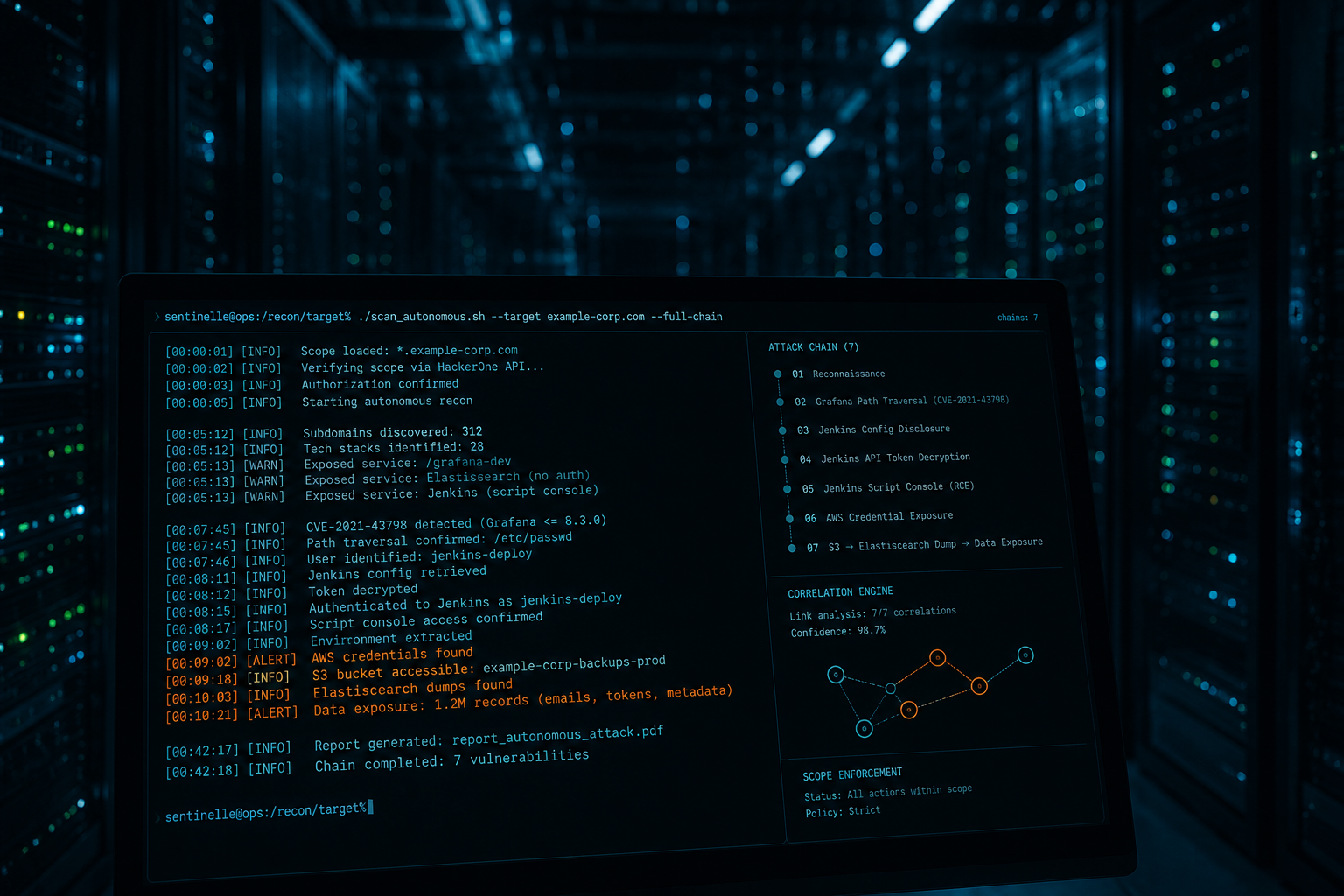
Autonomous pentesting platforms agents that run pentest-quality exploration continuously at subscription prices are collapsing that gap. Tools like Sentinelle run autonomous missions that include the exploitation depth of a pentest with the continuity of a scanner, at prices ranging from $79/month for solo practitioners to $700/month for firms running multi-client engagements.
This doesn't replace manual annual pentests for high-stakes environments human creativity still wins on business logic and social engineering. But it does close the 350-day blindness window that traditional annual pentesting leaves open. For most mid-market companies in 2026, the right answer is no longer "scan continuously, pentest annually" but "scan continuously, autonomous-test weekly, manual pentest annually."
What to Actually Buy in 2026
Pragmatic recommendations based on company profile:
Pre-revenue startup, < 20 employees: Start with a vulnerability scanner that fits your budget (Intruder, Detectify, Nessus Essentials). Add an autonomous pentest free tier for spot-checking critical assets. Skip manual pentest until you have real revenue or regulatory pressure.
Mid-market, 50-500 employees: Vulnerability management platform (Tenable, Qualys, Rapid7) plus an autonomous pentesting subscription on critical apps. Annual manual pentest from a reputable consultancy on the highest-stakes systems.
Enterprise, 500+ employees: All three layers, with dedicated personnel managing each. Autonomous pentesting is now used to cover the gaps between scheduled manual pentests, not to replace them.
Regulated industry (healthcare, finance, critical infrastructure): Whatever your compliance framework requires, plus continuous autonomous testing on production-facing surface area. The cost of a breach in these sectors is high enough that "we passed our annual pentest" stopped being a defensible position around 2024.
The Bottom Line
The vulnerability scan vs pen test debate isn't really a choice it's a sequence. Vulnerability scanning gives you broad, continuous, cheap visibility into known issues. Penetration testing gives you deep, contextual, expensive validation of real exploitability. You need both, and in 2026 you increasingly need a third layer in between: continuous autonomous pentesting that closes the gap traditional annual pentests leave wide open.
The companies that understand this distinction build security programs that actually reduce risk. The ones that don't end up paying for the wrong service, getting blindsided by what it missed, and learning the difference the hard way.
👉 Try Sentinelle's autonomous pentesting for free 3 missions, no credit card required. The bridge between continuous scanning and annual pentesting.
Did you enjoy this article?

Written by
Chris
Tech builder · Agentic AI & offensive security
A tech-obsessed builder, I'm building Sentinelle — an autonomous offensive-security AI agent. I write here about agentic AI, AI-assisted pentesting, and what I learn shipping offensive tooling.