Autonomous Pentesting: How AI Is Changing Offensive Security
Autonomous pentesting in 2026: how AI agents are changing offensive security, what they do better than humans, and where human pentesters still win.

Autonomous Pentesting: How AI Is Changing Offensive Security in 2026
For two decades, penetration testing followed the same rhythm: an engagement letter, two weeks of scoping, three weeks of manual testing by a senior consultant, and a $30,000 to $50,000 invoice. The model worked. It also left a gap nobody talked about companies tested once a year and lived dangerously the other 350 days.
That model is breaking apart in 2026. Autonomous pentesting penetration testing executed end-to-end by AI agents with little to no human in the loop has stopped being a research curiosity and become a category that's reshaping how offensive security actually gets done.
This guide explains what autonomous pentesting really is, how the underlying agents work, what they're already doing better than humans, where they still fall short, and how to think about integrating them into a security program in 2026.
What Is Autonomous Pentesting?
Autonomous pentesting is the practice of running a full penetration test reconnaissance, vulnerability discovery, exploitation, lateral movement, and reporting through an AI agent that plans and executes its own steps without continuous human direction.
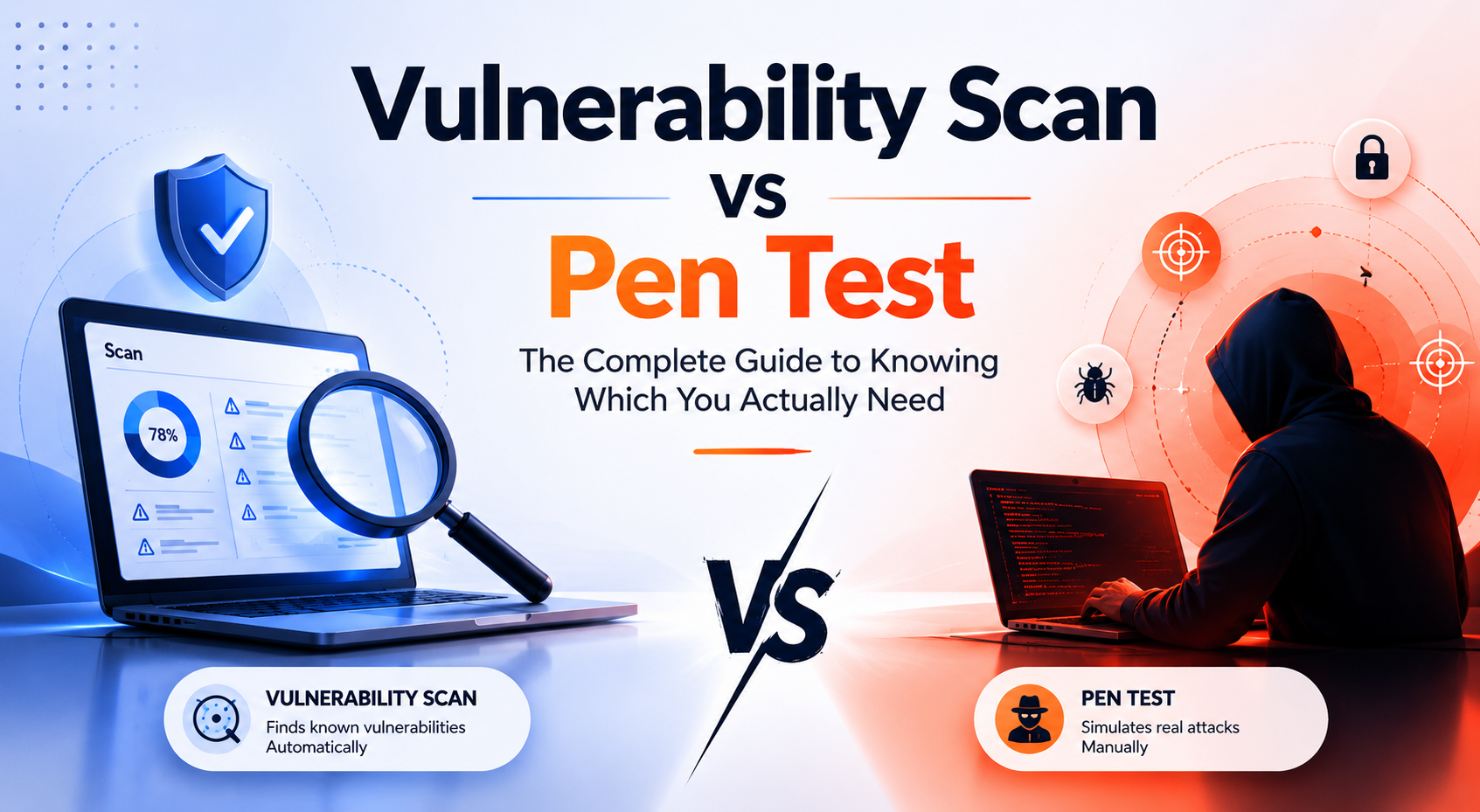
The distinction that matters: a traditional security scanner runs a fixed list of checks against a target and produces a flat list of findings. An autonomous pentesting agent does something fundamentally different. It reasons about the target, picks an attack path, runs tools, interprets the results, and decides what to try next based on what it just learned. When one approach fails, it pivots. When one finding suggests a deeper attack chain, it follows it.
The mental model: a traditional scanner is a checklist. An autonomous pentesting agent is a junior pentester with infinite patience and the ability to run 24/7 without coffee.
How Autonomous Pentesting Agents Actually Work
Strip away the marketing language and most autonomous pentesting systems share the same architectural pattern under the hood.
The orchestrator. A central LLM-driven planner receives the engagement goal and the scope. It decomposes the goal into sub-tasks (recon, then service enumeration, then targeted vulnerability checks, then exploitation attempts) and decides which specialist agent or tool handles each step.
The specialists. Below the orchestrator, specialized sub-agents handle narrower jobs one for reconnaissance, one for web testing, one for exploitation, one for reporting. PentAGI, an open-source project that hit 14,700+ GitHub stars in 2026, runs four such sub-agents inside Docker sandboxes. The hierarchical pattern outperforms single-agent approaches by 4.3× according to the HPTSA research benchmark which is why every serious player has converged on it.
The execution sandbox. Agents don't run commands on bare metal. They run inside isolated containers (Docker or microVMs) so that mistakes can't damage the host or leak into other engagements. This is non-negotiable for any platform handling client targets.
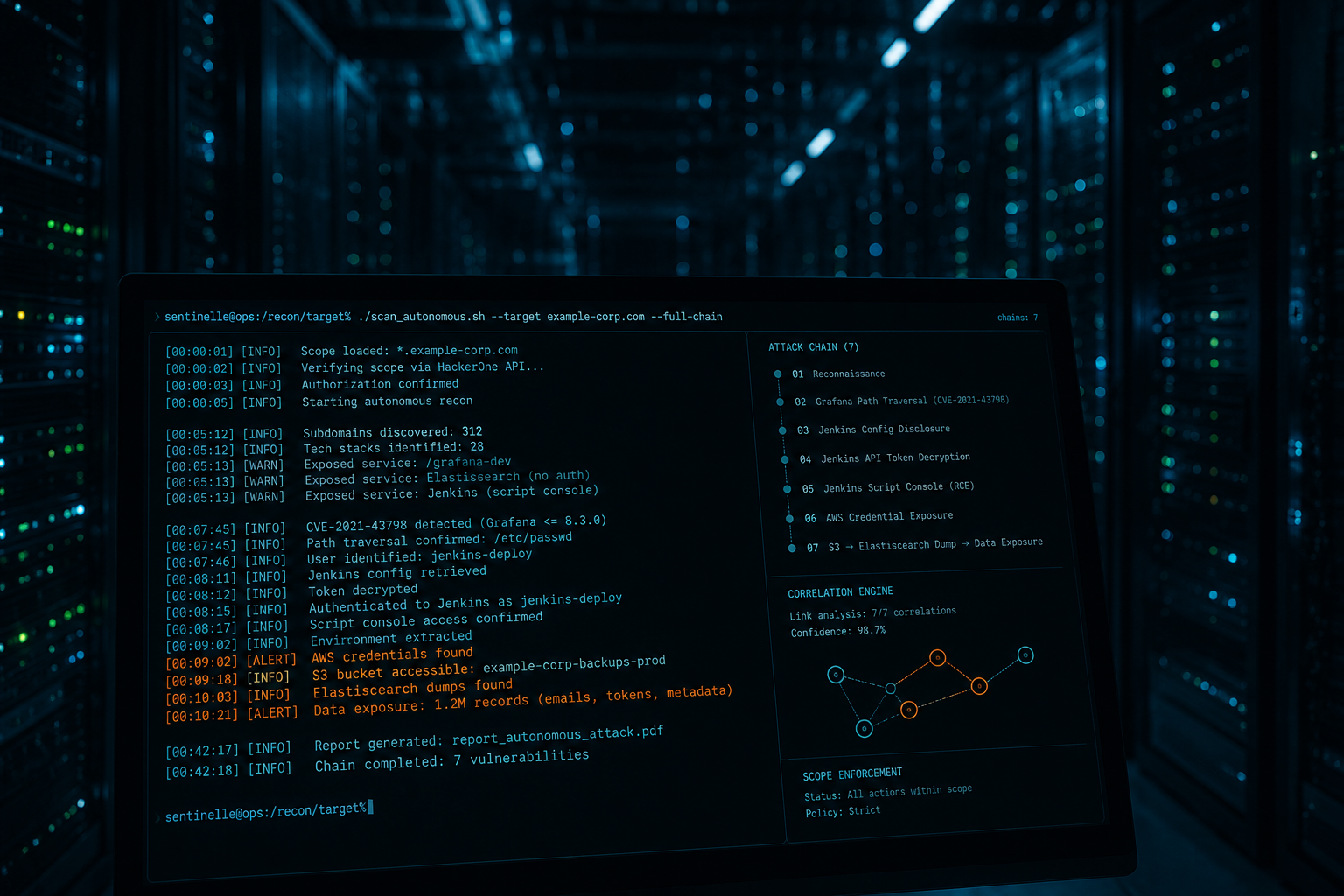
The memory layer. Findings, intermediate observations, and context get stored in a structured database usually SQLite or PostgreSQL so the agent can reason across long missions without losing track of what it already discovered. This is what enables attack chaining: noticing that a token leaked in step 3 unlocks an endpoint discovered in step 7.
The model selection logic. Modern autonomous pentesting platforms don't use one model for everything. They route deep reasoning tasks (exploit development, attack-path planning) to large models like Claude Opus 4.7 or GPT-5.2, and route fast lookup tasks (parsing tool output, formatting reports) to smaller, cheaper models. This is what makes the economics work.
What Autonomous Pentesting Agents Already Do Better Than Humans
Here's the part the industry has been quietly admitting throughout 2026. On certain tasks, autonomous agents already outperform skilled human pentesters not on creativity, but on speed, coverage, and consistency.
Continuous testing. A human pentester runs an engagement, delivers a report, and leaves. An autonomous agent runs the same engagement every six hours indefinitely. The moment a developer ships a new endpoint or a new subdomain appears, the agent finds it within the day.
Attack-path reasoning at scale. XBOW's autonomous agent reached #1 on HackerOne's global leaderboard with over 1,060 validated submissions. Horizon3.ai's NodeZero has run more than 170,000 autonomous penetration tests in production environments. These aren't lab numbers they're real bounties paid and real engagements delivered.
Zero-day discovery in production code. Google's Big Sleep found the first AI-discovered zero-day in production software a SQLite buffer underflow that OSS-Fuzz had been missing for years. Anthropic's Mythos Preview identified thousands of high-severity vulnerabilities across every major OS and browser in a single month.
Active Directory compromise. Current-generation autonomous agents now chain exploits and crack Active Directory environments in under 15 minutes work that used to consume the bulk of an internal pentest week.
Cost collapse. The traditional manual pentest costs $30,000 to $50,000 and runs once a year. Autonomous pentesting platforms now deliver comparable coverage for a fraction of that cost, monthly, on subscription pricing. That's the real disruption not the technology itself, but the business model it enables.
Automated Reconnaissance: The First Domino to Fall
If you only adopt one piece of autonomous pentesting in 2026, make it the recon stage. Reconnaissance is the most time-consuming part of a pentest and the most automatable.
Modern autonomous recon pipelines chain Go-native tools (subfinder, httpx, nuclei, katana) under an LLM orchestrator that decides what to do with the output. The flow looks something like this:
target domain
    ↓
passive subdomain enumeration (CT logs, DNS, third-party APIs)
    ↓
async liveness probing across all discovered assets
    ↓
fingerprinting (tech stack, framework, version)
    ↓
targeted vulnerability scanning (templates selected by fingerprint)
    ↓
LLM analysis: which findings actually warrant exploitation?
    ↓
sandboxed exploitation attempts on the highest-value targets
    ↓
structured report (Markdown / JSON / SARIF / PDF)
The big shift from 2024 to 2026 is the LLM analysis layer in the middle. Previous-generation recon automation produced 10,000 findings and dumped them on a human to triage. Current-generation autonomous agents triage their own findings, exploit the ones worth exploiting, and only surface what's actually actionable.
The Limits Nobody Is Allowed to Talk About in Marketing
Honest take: autonomous pentesting agents are not magic. The marketing in 2026 has gotten a bit ahead of the technical reality, and security leaders should know where the gaps are before they bet a budget on this category.
Business logic vulnerabilities. Agents are excellent at finding technical bugs (SSRF, IDOR, injection flaws, misconfigurations). They are still mediocre at finding business logic flaws the kind where a normal-looking request abuses an application's business rules to do something it shouldn't. Human pentesters still dominate here.
Creative attack chaining beyond two hops. Current agents chain attacks well within their immediate context but struggle with multi-stage scenarios that require holding a complex mental model over days. A skilled red teamer who spends two weeks building a campaign that pivots through five systems still beats any agent on the market.
Reasoning about social and physical attack vectors. Phishing, pretexting, physical access, supply chain manipulation autonomous agents don't touch these. They live in the network layer.
Hallucinated findings. LLM-driven agents occasionally invent vulnerabilities that don't exist or misclassify benign behavior as malicious. Sandboxed exploitation helps reduce this (an agent that can't actually exploit something it claims to have found gets a reality check), but human validation of critical findings remains mandatory.
Regulatory friction. The EU AI Act classifies many security automation tools as high-risk AI systems, with requirements around transparency, human oversight, and robustness that some autonomous pentesting agents may struggle to meet. This is going to be a major issue for European deployments in 2026 and beyond.
Why the Human Pentester Isn't Going Away
The honest framing for 2026 isn't "AI replaces pentesters." It's "AI handles 70% of the work that used to consume a pentester's week, freeing them to focus on the 30% where they actually add unique value."
That 30% is non-trivial. It's:
→ Business logic exploitation → Multi-stage red team campaigns → Social engineering and physical assessments → Adversarial creativity that AI doesn't yet reproduce → Client-facing communication and strategic risk advisory → Validation of agent findings before formal reporting
The pentesters who thrive in 2026 are the ones who treat autonomous agents like a junior consultant they manage delegating the grind, reviewing the output, and spending their own time on what only a human can do. The pentesters who get squeezed are the ones who built their careers on running Nessus scans and writing reports about CVE-2018-something.
The Future of Pentest: Where This Goes in 2027 and Beyond
The trajectory is clear. Three things are happening simultaneously:
1. Continuous pentesting becomes the default. The annual pentest model is going to look as antiquated by 2027 as annual antivirus updates do today. Continuous adversarial validation, running 24/7 against production, is becoming table stakes for serious security programs.
2. Specialized agents proliferate. We're already seeing the split LLM red teaming agents (Novee), mobile pentest agents, cloud pentest agents, Active Directory specialists. The generalist "do everything" platform of 2025 is fragmenting into vertical-specialized tools, each better than the generalist at its niche.
3. The market consolidates economically. XBOW reached a $1B valuation on $237M of funding. Pentera crossed $100M ARR. Intruder is targeting the midmarket with GCHQ-backed AI agents. The autonomous pentesting category is going to be one of the biggest categories in cybersecurity by 2028, and most of the spoils will go to the platforms that nail the agent-quality-meets-business-model equation now.
Where Sentinelle Fits in the 2026 Landscape
For practitioners who want to actually use autonomous pentesting today rather than wait for the dust to settle full disclosure, this is our product Sentinel is built around a few specific bets we've made about what the next phase of this market looks like.
Bet 1: The pentester is the customer, not the CISO. Most autonomous pentesting platforms are sold to security executives who buy them and hand them to teams. Sentinelle is sold to the practitioners who actually do offensive work freelance pentesters, bug bounty hunters, and startup security engineers. The pricing reflects it: $79/month for solo hunters, $349/month for freelance pentesters delivering consultant-grade engagements weekly.
Bet 2: Attack-path reasoning beats finding-counting. Many platforms compete on how many findings they surface. Sentinelle competes on whether those findings chain into proven exploitation. The agent runs sandboxed exploitation attempts and only ships findings with evidence no flood of theoretical alerts.
Bet 3: Bug bounty integration matters now. Sentinelle ships with native HackerOne and Bugcrowd integrations on paid plans, so hunters can pull their declared scope and launch a mission in two clicks. The first hours after a scope expansion are gold, and autonomous agents that can move at that speed have a real edge.
Bet 4: Reporting quality is product surface, not afterthought. Engagement reports are exported in Markdown, JSON, SARIF, or white-label PDF the latter being why Elite-plan customers are running entire pentest firms under their own brand on top of Sentinelle's agent.
The free tier ships 3 missions/month with 300K AI tokens per mission, which is enough to actually evaluate whether the technology works on your real assets not a demo against a contrived target.
Getting Started With Autonomous Pentesting in 2026
If you're a security practitioner who has never touched an autonomous pentesting agent, here's the realistic path to integrate one into your workflow without betting the farm:
Week 1: Spin up a free-tier mission on a target you own. Watch what the agent does, what it finds, and how it reports. Get a sense for the actual output quality versus the marketing claims.
Week 2: Run the same target through your usual manual recon process. Compare the gaps in both directions what the agent missed that you caught, and what the agent caught that you would have missed.
Week 3: Pick one repetitive part of your workflow (initial recon on new bug bounty programs, weekly scope re-validation on a client, continuous monitoring of an exposed surface) and delegate it to the agent. Free up that time for the work that requires human creativity.
Week 4: Decide. Either the agent is now part of your stack and you scale it up, or it's a tool you'll come back to in six months when the technology has improved further. Either way, you're now informed in a way that 95% of the cybersecurity industry isn't yet.
The transition to autonomous pentesting is happening whether the industry is ready or not. The practitioners who develop a real point of view on these tools what they're good at, what they're not, how to integrate them will be the ones still relevant in 2028. The ones who dismiss the category as hype, or treat it as a black-box replacement for human judgment, will both lose.
The middle path is the right path. Treat autonomous pentesting agents like power tools: enormously useful in skilled hands, dangerous in unskilled ones, and not a substitute for knowing what you're building.
👉 Try Sentinel for free 3 autonomous missions, no credit card required. Run your first AI-driven pentest mission in under a minute.
Did you enjoy this article?

Written by
Chris
Tech builder · Agentic AI & offensive security
A tech-obsessed builder, I'm building Sentinelle — an autonomous offensive-security AI agent. I write here about agentic AI, AI-assisted pentesting, and what I learn shipping offensive tooling.