Top 5 AI Tools for Offensive Cybersecurity in 2026
Top 5 AI tools for offensive cybersecurity in 2026: PentestGPT, Nuclei AI, Burp, Hexstrike, and Sentinelle — the autonomous agent that changes the game.


AI has completely reshaped the offensive security landscape. Where you used to need weeks of manual reconnaissance, hours writing payloads, and entire days correlating results today we have agents capable of planning, executing, and reporting a pentest mission with no human in the loop.
But between the marketing tools slapping "AI-powered" on any old scanner and the real solutions actually changing the game, how do you tell them apart? I've tested a good chunk of what's out there. Here's my honest top 5 of AI tools for offensive cybersecurity from useful sidekick to autonomous agent that genuinely changes the rules.
1. PentestGPT The Conversational Assistant for Pentesters
PentestGPT is probably the most well-known open-source project in the category. Developed by a team of researchers, it leverages GPT-4 to guide a pentester through the stages of a penetration test: reconnaissance, enumeration, exploitation, post-exploitation.
What it does well: maintaining context throughout a long mission, suggesting the next logical step when you're stuck, explaining vulnerabilities to a non-technical client.
Its limits: it's an assistant, not an executor. You still have to run the commands yourself, copy-paste the outputs, and the AI can hallucinate commands or CVEs that don't exist. Great for learning, limited for production work.
Who it's for: cybersecurity students, juniors looking to level up, pentesters who want a "second brain" to brainstorm with.
2. Nuclei AI Template Generation on Steroids
Nuclei is already a bug bounty classic. Its AI version adds an interesting layer: automatic template generation from freshly published CVEs, or from a natural-language description of a vulnerability.
What it does well: turning a PoC published on GitHub 2 hours ago into a Nuclei template ready to scan. Massive time-saver when a critical CVE drops and you need to check your exposure before attackers get to it.
Its limits: it's still a template-based scanner. No reasoning about attack chains, no pivoting, no contextual adaptation. It's a great tool but it's a tool, not an agent.
Who it's for: bug hunters looking to industrialize their CVE monitoring, blue teams doing continuous validation.
3. Burp Suite with AI Extensions The Augmented Proxy
Burp Suite remains the reference tool for web pentesting, and the AI extension ecosystem (BurpGPT, AI Auditor, etc.) gives it a second wind. These extensions automatically analyze intercepted requests and suggest payloads tailored to the application context.
What it does well: catching logical vulnerabilities (IDOR, broken access control) that classic scanners systematically miss. Analyzing complex HTTP responses and flagging anything that looks off.
Its limits: you pay in API tokens for every request analyzed it adds up fast on large engagements. And the AI doesn't decide, it suggests. The pentester stays in control from start to finish.
Who it's for: experienced web pentesters who want a targeted boost without giving up manual control.
4. Hexstrike AI The Open-Source Multi-Agent Framework
Hexstrike is a newer project pushing the multi-agent orchestration idea: several specialized LLMs (recon, web, exploitation, reporting) collaborate on a target. Conceptually more advanced than conversational assistants.
What it does well: delegating each task to a specialized agent, parallelizing work, producing a structured report at the end. The architecture is solid and the idea is compelling.
Its limits: young project, still a lot of friction at install and configuration time. Finding quality depends heavily on the backend model used (Claude or GPT-4 work much better than smaller open-source models). No managed infra you have to self-host everything.
Who it's for: offensive security researchers who want to experiment with multi-agent architectures, technical teams who want full control over their stack.
5. Sentinelle The Autonomous AI Agent That Finishes the Mission
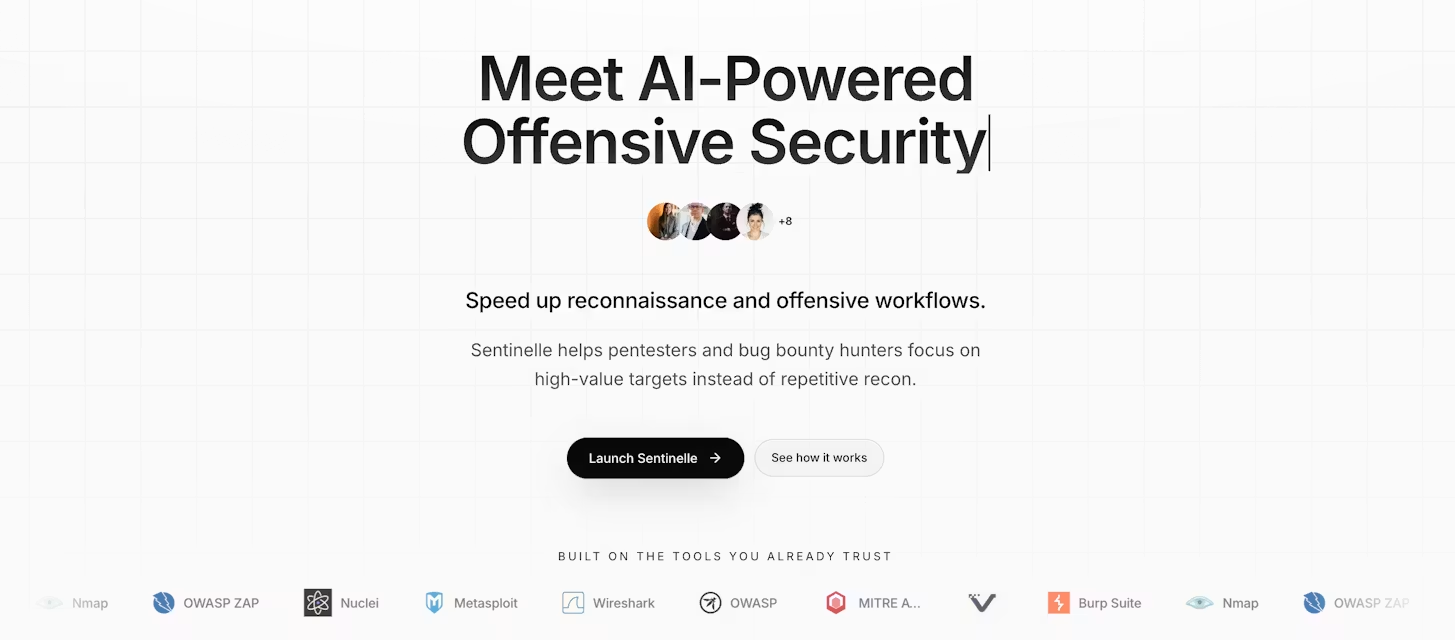
This is where we change categories. Sentinelle isn't an assistant that suggests, isn't a scanner that templates, isn't a proxy that analyzes it's a fully autonomous offensive security agent. You give it a scope (a URL, a CIDR, a GraphQL schema), rules of engagement, and it handles the rest: reconnaissance, vulnerability detection, sandboxed exploitation, and final report delivered in Markdown, JSON, SARIF, or white-label PDF.
What truly sets it apart:
→ Attack-path reasoning. Where most tools spit out a flat list of findings, Sentinelle chains logical steps, pivots, and pushes all the way to proven exploitation. As one independent pentester who tested it put it: "It's the first time an agent actually felt like it was hunting."
→ Continuous adaptation. Unlike a scanner that fires a battery of checks and stops, the agent adjusts its strategy based on what it discovers. A weird response on an endpoint triggers targeted exploration not another generic hammer blow.
→ 18 built-in playbooks covering the classics (auth bypass, JWT, IDOR, SSRF, OAuth, deserialization) — plus the ability to write your own custom recipes on the Hunter, Pro, and Elite plans.
→ Signal without noise. No flood of useless alerts. Every finding surfaced is exploitable, proven, and shipped with enough context to act on. For teams tired of drowning their analysts in false positives, this is a real difference.
→ Native bug bounty integrations direct HackerOne and Bugcrowd connections on paid plans, so you can pull your programs and launch a mission on the declared scope in two clicks.
→ GDPR-compliant with EU hosting (FR residency option on Elite) and encryption at rest. Important if you handle European clients.
Pricing is built for different profiles:
Test drive (free) 3 missions/month to evaluate
Hunter ($79/month) for solo bug bounty hunters
Pro ($349/month) for freelance pentesters delivering consultant-grade work weekly
Elite ($700/month) for those running a pentest firm under their own brand (white-label PDF reports)
Who it's for: bug bounty hunters who want to map the surface before anyone else does, freelance pentesters who want to industrialize their recon and first-wave exploitation, and startups that don't have the budget for an internal red team but want a credible offensive layer running continuously.
The honest take: Sentinelle doesn't replace a human pentester. Final validation and offensive creativity stay human that's the team's explicit positioning, not a marketing hedge. But on the automatable parts (and that's 70-80% of the real time spent on a mission), it saves a serious amount of time.
How to Choose Based on Your Profile
If you're new to offensive security: start with PentestGPT to learn the methodology, then level up with Burp + AI extensions when you're ready to touch real targets.
If you hunt bugs solo: Nuclei AI for your daily CVE monitoring, and Sentinelle Hunter to map the surface of your HackerOne/Bugcrowd programs before other hunters get there.
If you're a freelance pentester: Burp for precise manual work, and Sentinelle Pro to automate recon and first-wave exploitation on your client engagements you save 10-15 hours per mission.
If you want to experiment technically: Hexstrike to tinker with multi-agent architectures, or the free version of Sentinelle to see what a productized agent actually looks like.
Offensive AI in 2026: Where Are We Headed?
In less than two years, we've moved from assistants that suggest to agents that execute end-to-end. Anthropic's Project Glasswing showed that an AI can identify over 10,000 critical vulnerabilities in a month on real code. Sentinelle proves that this kind of capability can be packaged into a product usable day-to-day by a pentester or a bug hunter.
The question is no longer "will AI replace pentesters?" it's "do you want to be the pentester who uses these tools, or the one being outpaced by those who do?"
The tools in this top 5 are available today. Your move.
👉 Try Sentinelle for free 3 free missions, no credit card required. Launch your first autonomous mission in under a minute.
Did you enjoy this article?

Written by
Chris
Tech builder · Agentic AI & offensive security
A tech-obsessed builder, I'm building Sentinelle — an autonomous offensive-security AI agent. I write here about agentic AI, AI-assisted pentesting, and what I learn shipping offensive tooling.